Step 01
Free diagnostic
A visit to the station and a session with quality and production: where your records sit, how long reconstructing a batch file takes today, and what your buyers actually require.
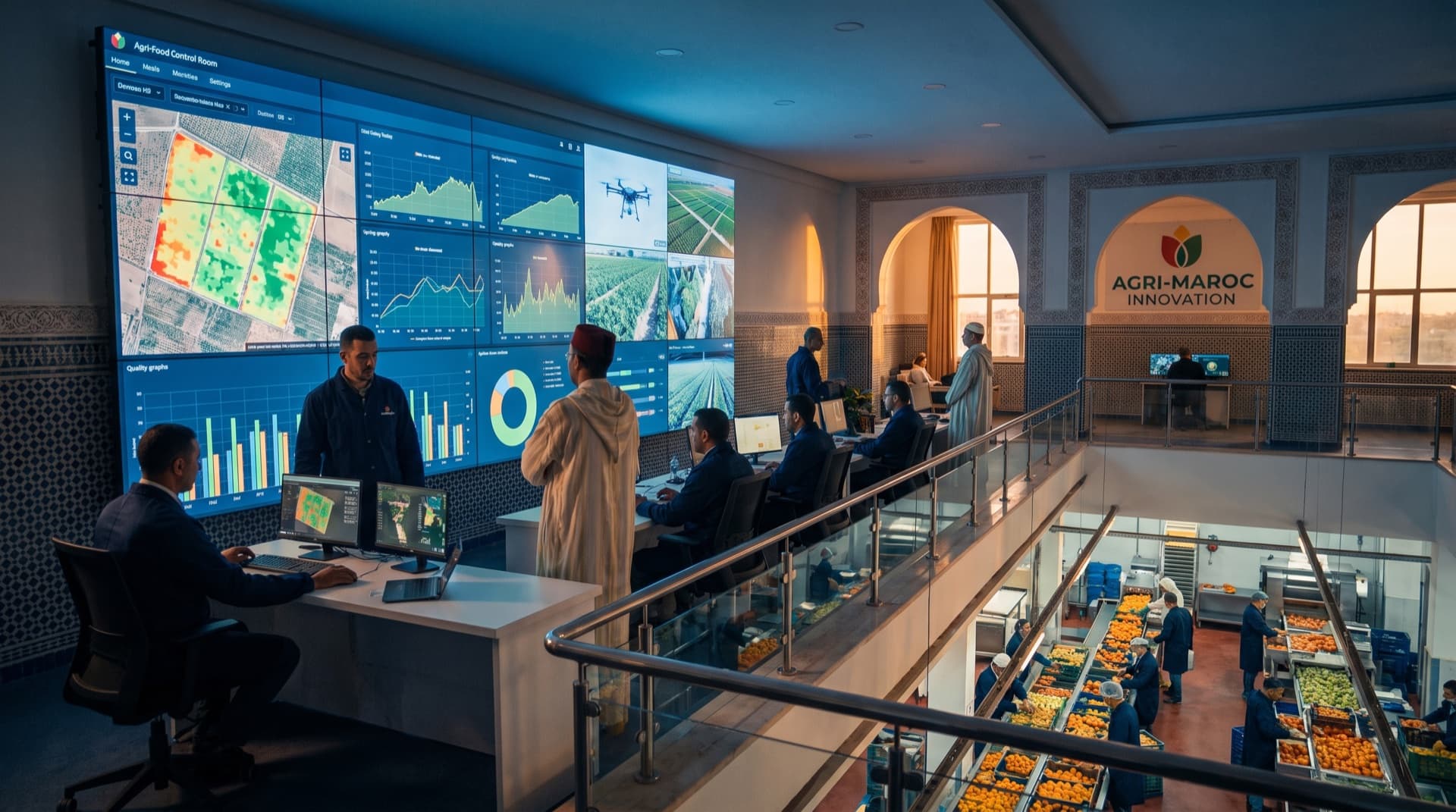
Sector — Agri-food industry
AI in Morocco's agri-food industry: batch traceability, quality audits, European buyers' specifications, ONSSA compliance and season-long campaign steering.
In brief
Morocco's agri-food industry exports to buyers who demand complete traceability, private quality standards and impeccable food-safety compliance. Generative AI works on that documentary burden: reconstructing a batch file, preparing audits, answering buyer specifications, carrying the lessons of one season into the next. The food-safety framework is set by ONSSA and by the requirements of the destination market.
A Moroccan packing station knows how to grow, sort, grade and ship. What wears it down is not production — it is proof. Proving a batch's origin, proving that pre-harvest intervals were respected, proving conformity to the specifications of a European retailer that revised its requirements in February, proving all of it to an auditor who arrives with forty-eight hours' notice.
This documentary burden rests on a handful of quality managers, often working alone, with spreadsheets, binders and memory. It is seasonal, it is intense, and it is the most common breaking point in the sector — an incomplete file means a container stuck at the port, sometimes a delisting. This is exactly the terrain where generative AI produces an immediate effect, without touching the agronomic craft itself.
Updated 14 July 2026
Sector stakes in Morocco
Two levels of requirement stack up for a Moroccan exporter. The first is sanitary and regulatory: ONSSA approves establishments, monitors the food safety of products and certifies conformity for export, while the destination country — the European Union first and foremost — applies its own import controls, notably on residues and on sanitary and phytosanitary conformity. A gap is not up for debate: the batch is rejected, and the notification follows the exporter well beyond the shipment concerned.
The second level is contractual, and it is often more demanding than the first: European retailers and importers impose their own private standards — GlobalG.A.P. on the production side, IFS or BRCGS on the processing side — bundled with audits, sometimes unannounced, and with specifications specific to each client. Every buyer has its own; they change; and keeping them all up to date in a station that supplies twelve different clients is a documentary feat. Add to this the water constraint, which now weighs on every campaign decision, and the framework of the Génération Green strategy, which pushes the sector towards more added value and structure. AI solves none of these challenges for you; it simply makes proof possible without adding headcount.
Approvals, inspections, export certificates: a sanitary gap blocks a batch and leaves a lasting trace. The documentation must be available immediately, not reconstructed in a rush.
GlobalG.A.P., IFS, BRCGS and specifications specific to each retailer: so many bodies of rules to keep current, cross-check and evidence in audits, often unannounced.
Tracing back from a pallet to its plot, its inputs and its checks must be a matter of minutes. That delay is what decides the scale of a recall.
The documentary load explodes during the campaign, when no one has the time. A useful assistant is one that holds up in peak season, not in January.
Use cases
Every use case links to the Hunter BI offer that delivers it. We claim no result figures until they are measured at your organisation.
Sovereignty
A station's data — yields per plot, production costs, quality gaps, prices negotiated with buyers, harvest schedules — traces the company's exact competitive position. In a sector where a few European buyers face many Moroccan exporters, this is precisely the information a buyer would dream of holding before a negotiation. Pouring it into a service whose retention and access regime you do not know is not a compliance mistake: it is a strategic one.
There is also a more prosaic constraint: stations are rarely in the city centre. Connectivity there is sometimes poor, and the season does not wait. A sovereign deployment — an inference server on site, your documents indexed locally — solves both problems at once: the data stays with you, and the assistant keeps answering when the link weakens, at the very moment you need it. For uses with nothing at stake — market monitoring, sales writing, translation — the enterprise cloud remains perfectly suited. It is this split, not an ideological choice, that we establish at the diagnostic.
Where to start
Start with the file that costs you the most when it is missing: the batch file, or the audit file. The demonstration runs on your own season archives.
Step 01
A visit to the station and a session with quality and production: where your records sit, how long reconstructing a batch file takes today, and what your buyers actually require.
Step 02
The pilot is prepared and tuned off-peak, on the archives of the past season, so it is operational when the load arrives. The agricultural calendar commands — not the other way round.
Step 03
The assistant goes into production for the season, with close supervision in the first weeks, then a maintenance subscription: it is under full load that a tool proves its worth.
No, and you would not want it to. Your traceability system is the source of truth, and it must stay that way: AI sits on top, to query in natural language data spread across that system, spreadsheets and scanned paper documents. It closes the gap between what you record and what you can retrieve under pressure.
No, it is common and it is workable. Digitising season records is often part of the first workstream, and it has value in its own right, independent of AI. We do not make starting conditional on full digitisation: we begin with the corpora that are already usable and extend from there.
It guarantees nothing — it prepares and it alerts. Compliance is attested by your checks, your analyses and the competent bodies; the assistant flags that a record is missing, that an interval has not been respected or that a specification has changed. Responsibility for the shipment remains entirely yours, and the setup is designed to keep it that way.
The framing and the pilot, yes, as far as possible: mobilising a quality team in peak season is the surest way to sink a useful project. The diagnostic, though, can happen at any time — and it is precisely what lets you prepare the work so it is ready for the opening of the next season.
The criterion is not size but documentary intensity: a mid-sized station that supplies several European retailers, with several standards and regular audits, often has more to gain than a large group already equipped with a well-staffed quality department. That is what the diagnostic measures, before any commitment.
A free scoping session with a Hunter BI consultant: your data, your regulatory framework, the use cases worth launching first — and the ones better set aside.