Step 01
Free diagnostic
Together we pick a line or a workshop, look at where time is lost — document searching, file reconstruction, waiting on someone who knows — and what is actually digitised.
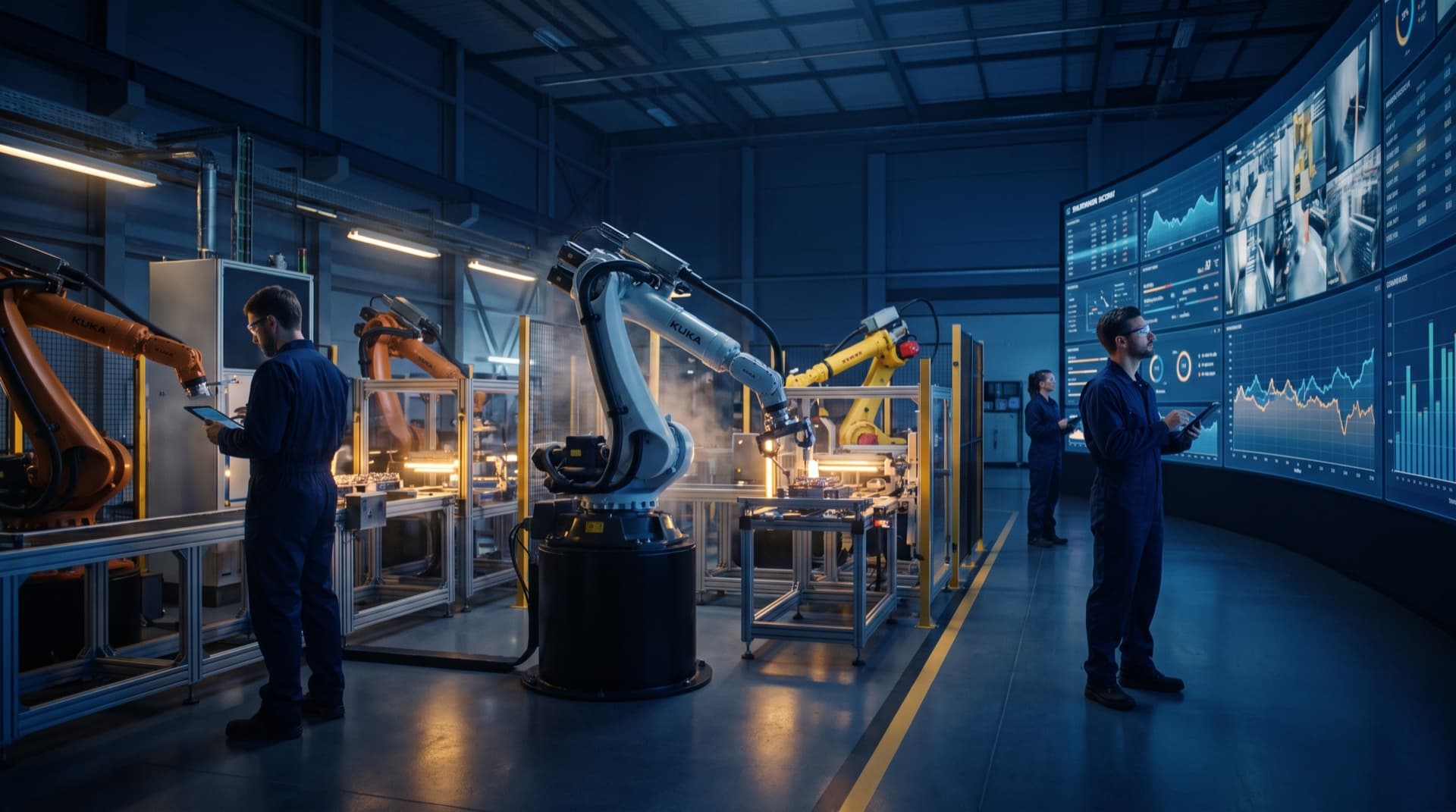
Sector — Industry
AI use cases in Moroccan industry: maintenance, quality, traceability and the demands of European clients. Sovereign, on-premise deployment.
In brief
In a plant, the knowledge already exists: work instructions, drawings, procedures, incident reports, maintenance histories. It is simply unreadable under pressure. Generative AI makes it queryable in plain language, right by the line, even with no internet connection. The Moroccan stakes are traceability, the quality demanded by European clients and the transfer of know-how. Hunter BI deploys these assistants on-premise, without letting your drawings leave the building.
An operator standing in front of a stopped line does not open a document portal. They call the technician who knows — and if that technician is on leave, the line stays down. This is where most of AI's value lies in Moroccan industry: not in one more dashboard, but in immediate access to what the company already knows.
Moroccan plants — automotive and aerospace subcontracting, wiring, textiles, chemicals, materials — share one trait: they produce for demanding clients, often European, who impose quality standards and full traceability. Every non-conformity must be documented, every batch tied to its chain, every audit prepared. This documentary work ties up quality engineers and production managers whose real job lies elsewhere. That is precisely what we take off their plate.
Updated 14 July 2026
Sector stakes in Morocco
A Moroccan plant exporting to the European Union does not just face regulation: it faces client specifications. Quality standards imposed by the customer, upstream and downstream traceability requirements, an obligation to demonstrate that the product conforms to the standards applicable in its destination market, supplier audits carried out without notice. The penalty for a documentary gap is not administrative — it is commercial: a batch held, an audit left unresolved, a contract lost. Yet most of this burden rests on documents scattered across the ERP, the CMMS, quality spreadsheets and the memory of long-serving staff.
Two local realities compound this pressure. The first is transmission: a line's know-how is passed on by word of mouth, and the departure of a team leader carries off years of settings, workarounds and fixes that were never written down. The second is connectivity: a share of Moroccan workshops run on an unstable network, sometimes deliberately isolated from the information system for industrial-security reasons. An AI assistant that demands a permanent connection to an external service simply has no place there. So we design for the real plant: on-premise, on your documents, with no dependence on an internet link.
Tying a batch to its materials, settings and inspections remains a contractual requirement from clients. AI speeds up reconstructing the file; it does not replace the production data itself.
Non-conformities, corrective actions, evidence to produce at audit: dense documentary work, where the searching costs more than the analysis.
Drawings, work instructions and process parameters are your edge. They have no reason to pass through an external service: deployment runs on your own infrastructure.
Unstable networks, isolated environments, operators at their stations: the assistant must run on-premise, in French and Arabic, without depending on a permanent connection.
Use cases
Every use case links to the Hunter BI offer that delivers it. We claim no result figures until they are measured at your organisation.
Sovereignty
A part drawing, a machining routing, a process parameter: this is the value the company has accumulated, and often the value of your client. Many principals put it in black and white in their contracts — technical documents must not be disclosed to third parties or pass through unauthorised services. An AI assistant wired into an external service is a third party. The question, then, is not whether you trust a model provider, but whether you can demonstrate to your client that their drawings have not left your premises.
Sovereign deployment meets that requirement in the only convincing way: the models run inside your infrastructure, your technical documents are indexed locally, and nothing crosses the firewall. It is also the answer to the shop floor's connectivity problem — an on-premise inference server keeps responding when the internet link drops, which is no small matter when the line itself does not stop. We size these installations for the plant's real usage, without over-provisioning: sovereignty is not a data centre, it is a boundary held.
Where to start
In industry, the proof happens on a line, not in a slide deck. A narrow scope, real documents, a technician who judges the result the same day.
Step 01
Together we pick a line or a workshop, look at where time is lost — document searching, file reconstruction, waiting on someone who knows — and what is actually digitised.
Step 02
An assistant wired into one line's documents, evaluated by the people who use it. The metric is simple and measured beforehand: search time, downtime on documented faults, the quality of the files produced.
Step 03
The assistant extends to the other lines and the support functions, with a per-seat subscription, continuous supervision and the gradual addition of sources — CMMS, ERP, drawings.
No, and that is in fact the main argument for sovereign deployment in industry. The open models run on your infrastructure, your technical documents are indexed locally, and no content crosses your firewall. You can thereby demonstrate to your client that their documents have not been disclosed to a third party — a requirement often written into the contract.
Yes, if the architecture provides for it. An inference server installed on-premise responds without an internet link: this is one of the most common reasons for choosing sovereign in an industrial setting, ahead even of confidentiality. Workshops isolated from the information system for industrial-security reasons are handled the same way.
No. It assembles the elements — inspections, deviations, comparable cases, the requirements of the specification — and prepares the decision file. The quality decision remains that of an authorised manager, and it must stay that way: it is they who commit the company before the client and, where applicable, before the certification body.
You need documents, not an Industry 4.0 plant. Most of the sites we work with have manuals in PDF, quality spreadsheets and a partially populated CMMS: that is enough for a first useful assistant. Digitising production data adds more, but it is not the prerequisite — waiting until you are ready is the surest way never to begin.
Their own. Our industrial deployments are built for teams that work in French and Arabic, with documentation often written in French or English: the assistant reads the source in its original language and answers in the operator's, citing the exact document and its version.
A free scoping session with a Hunter BI consultant: your data, your regulatory framework, the use cases worth launching first — and the ones better set aside.