Parlons de votre prochain projet IA.
Un logiciel à connecter, une tâche à simplifier, une équipe à accompagner ? Demandez un échange de 30 minutes pour faire le point et définir la suite.
How francophone African SMEs adopt generative AI — Claude, OpenAI and the intelligent ERP — despite connectivity, cost and data-sovereignty constraints.
Published 28 July 2026
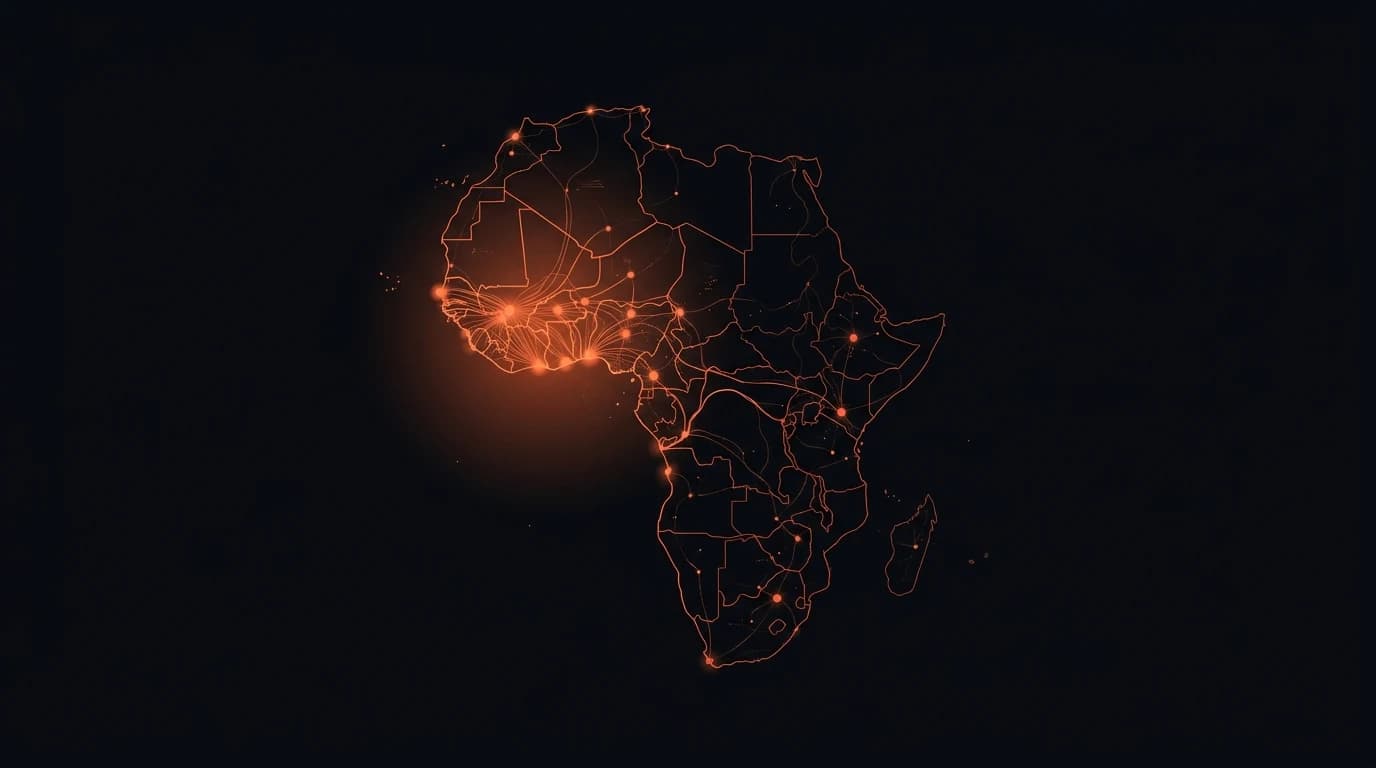
Generative AI is no longer a laboratory curiosity reserved for Silicon Valley. For an SME in Dakar, a distributor in Abidjan, a bank in Cotonou or an accountancy practice in Lomé, models such as Claude (Anthropic) and GPT (OpenAI) are available today, in French, from a browser. The real question is no longer "does it work?" but "how do we integrate it usefully, at a sustainable cost, while respecting our data and our regulations?" This article surveys the opportunity — and the genuine constraints — of generative AI for enterprises across francophone Africa, with particular attention to the AI-powered ERP, data sovereignty and training.
Hunter BI is an AI consulting and engineering firm based in Casablanca. We are members of the OpenAI and Anthropic partner networks (a Claude partner and reseller), an official WhatsApp Business API partner, and partners of HubSpot, Fortinet and Yeastar. Our geographic and linguistic position makes Morocco a natural gateway towards the francophone markets of West and Central Africa. What follows is a practitioner's reading of the ground — with no invented figures and no fabricated case studies. Only what is reasonably achievable, and what deserves caution.
Several structural forces are converging. First, demography: francophone Africa is young, increasingly urban and increasingly connected through mobile. Second, language: French is an official or working language across much of West and Central Africa — Senegal, Côte d'Ivoire, Benin, Togo, Mali, Burkina Faso, Guinea, Cameroon and Gabon among others — and the leading generative models handle French to a very high standard. A tool like Claude or GPT does not need to be "translated" to be useful to a French-speaking team; it drafts, summarises, classifies, extracts and converses directly in the working language.
Finally, economic conditions push organisations to do more with less. Many businesses in the region operate with lean teams, processes that are still partly manual, and limited access to costly specialist software. This is precisely where generative AI delivers the most value: it acts as an augmented colleague that absorbs repetitive, low-value tasks — commercial writing, first-line replies, data entry and normalisation, document summarisation — without requiring a heavy IT programme.
That said, realism matters. Generative AI is not magic: it amplifies an organisation that already works, it does not repair one that does not. In practical terms, digital transformation with AI in Africa succeeds when it starts from a precise, measurable use case and from clean data — not from the purchase of a technology. This is the difference between genuine AI solutions for African SMEs and expensive shelfware.
An honest account of AI in francophone Africa has to name the frictions, because they shape the architecture of any solution.
These constraints do not cancel the opportunity — they define it. They explain why, in francophone Africa, mobile-first, frugal, use-case-driven architectures outperform large "platform" projects imported wholesale.
If we had to keep just one field of application, it would be the intelligent, AI-powered ERP. The ERP — the software that runs sales, purchasing, inventory, accounting and payroll — is the backbone of a company. It is also where the repetitive tasks that generative AI can lighten are concentrated, which makes the AI-powered ERP in Africa one of the most tangible entry points into the technology.
What does an "intelligent" ERP actually look like? It is not about replacing the ERP, but adding a layer of natural language and automation on top of it. Here are illustrations — stated conditionally, because they are design patterns, not measured results at any client:
Technically, a Claude + Odoo integration in Africa is entirely feasible: the ERP remains the source of truth for the data, and the model is called via API for the language tasks, with guardrails that prevent any unvalidated write-back. One clarification, to avoid any misunderstanding: we are not an Odoo publisher and we are not a certified Odoo integrator — we describe here a possible engineering approach around an open-source ERP that is widely used in the region. The same principle applies to other ERP systems.
One essential point of vigilance for francophone Africa: accounting in the OHADA area follows the SYSCOHADA framework, distinct from the standards used elsewhere. Any AI layer connected to accounting must respect this chart of accounts and its rules. This is exactly the kind of regional specificity that a firm far from the ground overlooks, and that a partner rooted in the francophone space treats as native. For more on the available software building blocks, see our AI platforms page.
AI data sovereignty in Africa is often treated as a slogan. In francophone Africa it is, first and foremost, a concrete legal reality.
Several countries in the region have established data-protection authorities and laws: the CDP in Senegal, the ARTCI in Côte d'Ivoire and the APDP in Benin among others, while Morocco has the CNDP (Law 09-08). At the continental level, the African Union Convention on Cyber Security and Personal Data Protection — known as the Malabo Convention — entered into force in 2023 after reaching the required number of ratifications. The direction of travel is clear: organisations will increasingly have to document where and how their data is processed, in particular the personal data of their customers and employees.
For a generative AI project, this implies explicit architectural choices:
These topics deserve dedicated framing: we detail them on our AI governance and sovereign AI pages. The aim is not to frighten but to make adoption durable: AI deployed without governance is a debt that always comes due.
One question comes up constantly: "should we choose Claude or OpenAI?" The honest answer is: it depends on the use case, and nothing forces you to pick a single house. A well-designed architecture can route each task to the most suitable model — and for many organisations across Africa, the right answer is to keep both Claude AI and OpenAI solutions available.
A few practical markers, with no brand hierarchy:
The role of a firm that is a partner of both OpenAI and Anthropic is precisely to stay neutral: to recommend on the basis of real need, not an exclusive contract. Different sectors have different needs, which we explore on our sectors page.
You can install the best technology in the world; if the teams cannot use it, the project fails. In francophone Africa as elsewhere, AI training for African enterprises is the decisive factor — and the one most often left out of budgets.
Training is not a one-hour lecture. It is:
A company could typically get more value from a targeted half-day of training per function than from an additional, unaccompanied subscription. It is a matter of common sense: adoption comes before tooling. A well-run training programme always starts from the real tasks of the teams, not from theory.
Morocco occupies a distinctive position: an African anchor, linguistic proximity to francophone Africa, established economic ties with West and Central Africa, and a time zone convenient for working through the day with Dakar, Abidjan or Douala as well as with Europe. For an AI project, working with an AI consultant with West Africa in mind offers concrete advantages:
We owe one point of honesty: Hunter BI is a young firm. We claim no track record, no public portfolio of references and no project volumes. What we put forward are real partnerships and a method. The rest is judged on the evidence, in a first conversation.
For a francophone African enterprise that wants to move from intention to action, a realistic path looks like this:
This approach — small, measurable steps — is what separates projects that last from demonstrations with no tomorrow. If you would like a structured starting point, our AI diagnostic is designed exactly for this framing stage.
Does generative AI really work well in French for professional use in Africa? Yes. Leading models such as Claude and GPT handle French to a very high standard, including for demanding professional tasks (writing, summarisation, extraction). The main limits come not from the language but from the quality of the data provided and from connectivity. For local languages (Wolof, Bambara and others), performance is more variable and calls for case-by-case testing.
What budget should we plan to get started? There is no single figure, and you should be wary of anyone who promises a precise number without knowing your context. Cost depends on usage volume (billed in tokens), on the model or models chosen, and on scope. A sound approach is to start with a narrow pilot, measure the real cost, then decide whether to extend. A local partner can also carry billing in foreign currency, which simplifies access in the CFA franc zone.
Is our data safe if we use Claude or OpenAI? It depends on the offering and the architecture. The enterprise offerings from OpenAI and Anthropic include confidentiality commitments, in particular not to train the models on your data. Beyond the contract, the best protection remains to transmit only what is necessary and to frame usage with written governance. That is the core of our work on AI governance and sovereign AI.
Do we have to replace our ERP to make it "intelligent"? No, in the large majority of cases. The recommended approach is to add an AI layer to the existing ERP via API, keeping it as the source of truth, rather than replacing everything. For a widely used open-source ERP such as Odoo, the integration is technically direct — provided the regional accounting specifics are respected (the SYSCOHADA framework in the OHADA area). Note that we are not a certified Odoo integrator; we describe an engineering approach, not a vendor certification.
Does Hunter BI work only in Morocco? No. Our Casablanca base is a point of support, but our vocation is to accompany enterprises across francophone Africa, in particular West and Central Africa, remotely and on site as needs require.
Generative AI offers francophone African enterprises a rare chance to leapfrog: to automate tasks, serve customers better and professionalise operations without disproportionate software investment. But the opportunity is realised neither by technology alone nor by grand declarations. It is realised through a well-chosen use case, clean data, clear governance and trained teams.
Hunter BI — an AI consulting and engineering firm based in Casablanca, a member of the OpenAI and Anthropic partner networks — offers itself as an African gateway for this journey, with a commitment to candour about what is feasible and at what cost. We do not sell miracles and we do not cite results we have not achieved. We offer a method and a first conversation.
If you want to identify your priority use case and assess its feasibility, start with an AI diagnostic or write to us via our contact page. The first step costs little; not taking it often costs more.

Un logiciel à connecter, une tâche à simplifier, une équipe à accompagner ? Demandez un échange de 30 minutes pour faire le point et définir la suite.